Solving Stability Challenges: How to Maximize Matcha Performance in Industrial Food & Beverage Applications
Matcha’s vibrant green color, clean-label appeal, and functional benefits make it a compelling ingredient for modern food and beverage innovation. But when scaled from artisanal kitchens to industrial production lines, matcha can present significant stability challenges—particularly around color degradation, flavor oxidation, and particle dispersion.
Left unaddressed, these issues lead to inconsistent batches, shortened shelf life, consumer complaints, and wasted investment. The good news? With the right formulation strategies, processing controls, and supplier partnerships, matcha can perform reliably—even in demanding industrial environments.
Here’s a practical guide to overcoming matcha’s stability hurdles at scale.
1. The Core Stability Challenges of Matcha
🎨 Color Fading (Chlorophyll Degradation)
- Cause: Chlorophyll—the pigment behind matcha’s green—is sensitive to:
- Light (especially UV)
- Heat (above 70°C/160°F accelerates breakdown)
- pH (turns olive/brown in acidic conditions < pH 5.0)
- Oxygen exposure (oxidation over time)
☕ Flavor Deterioration
- Fresh matcha has umami sweetness and minimal bitterness.
- Over time or under stress, catechins oxidize, leading to hay-like, stale, or overly astringent notes.
💧 Poor Dispersion & Sedimentation
- In liquid systems (RTD beverages, dairy alternatives), coarse or improperly processed matcha can clump, settle, or create grittiness—especially without homogenization.
2. Proactive Solutions for Industrial Formulators
✅ 1. Control pH Strategically
- Keep final product pH above 5.0 whenever possible.
- In acidic applications (e.g., kombucha, fruit smoothies), consider:
- Buffering with citrate or phosphate systems
- Using microencapsulated matcha (emerging tech)
- Blending with small amounts of spirulina (for blue undertone to counteract browning)—verify clean-label compliance
📌 Real-world tip: A yogurt drink at pH 4.2 will turn brown within weeks; at pH 5.3, it stays green for months.
✅ 2. Optimize Processing Conditions
- Add matcha late in the process—after high-heat steps like pasteurization or UHT treatment.
- Use cold-blend or post-sterilization dosing for RTD beverages.
- For dry blends (protein powders, baking mixes), ensure low-moisture environment (<5% RH) to prevent caking and oxidation.
✅ 3. Choose the Right Grade & Particle Size
- Ultra-fine matcha (<15 microns) disperses better in liquids and resists sedimentation.
- For baked goods, slightly coarser grades may suffice—but ensure consistent milling to avoid speckling.
- Work with suppliers who offer application-specific grades (e.g., “beverage-stable” or “high-heat resistant”).
✅ 4. Leverage Packaging as a Shield
- Use opaque, UV-blocking bottles or pouches (amber, white, or aluminum-lined).
- For dry products, opt for nitrogen-flushed, vacuum-sealed bags with oxygen absorbers.
- Avoid clear glass or transparent PET for liquid matcha products—no matter how “Instagrammable.”
✅ 5. Partner with Suppliers Who Provide Stability Data
Ask for:
- Accelerated shelf-life testing (ASLT) reports under your target conditions
- Color retention curves (L*, a*, b* values over time)
- Particle size distribution and moisture content (<4.5% ideal)
- Batch-specific COAs for heavy metals, pesticides, and microbial safety
A proactive supplier may even co-develop stabilization protocols with your R&D team.
3. Case Study: Stabilizing Matcha in a Plant-Based RTD Latte
Challenge:
A brand launched a refrigerated oat milk matcha latte, but after 4 weeks, the color shifted from bright green to muddy khaki, and consumers reported “bitter aftertaste.”
Solution:
- Switched to a finer, spring-harvest matcha with higher chlorophyll content
- Adjusted pH from 4.8 → 5.4 using natural citric acid buffering
- Added matcha post-pasteurization via sterile inline dosing
- Packaged in white HDPE bottles with light barrier
- Included vitamin C (ascorbic acid) at 0.1% as a natural antioxidant
Result: Shelf life extended from 4 to 12 weeks with stable color and clean flavor.
4. Future-Proofing: Emerging Stabilization Technologies
- Microencapsulation: Encasing matcha in lipid or polysaccharide matrices to protect against pH, heat, and oxygen.
- Enzyme inactivation: Advanced steaming techniques to preserve catechins longer.
- Hybrid color systems: Combining matcha with other natural greens (e.g., alfalfa, chlorella) for enhanced stability—while maintaining clean labels.
While not yet mainstream, these innovations are becoming more accessible to mid-sized manufacturers.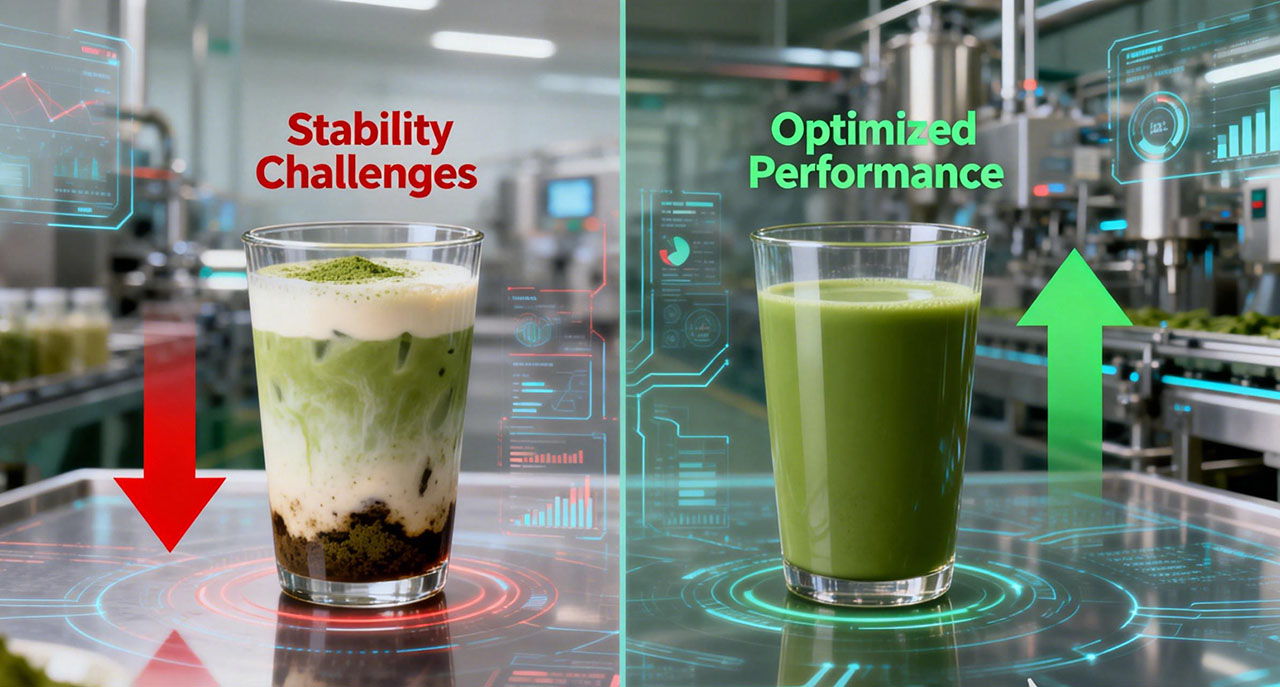
Final Thought: Stability Is a System—Not Just an Ingredient
Matcha doesn’t fail in industrial applications—formulations do. By treating stability as a holistic challenge involving ingredient selection, process design, packaging, and supplier collaboration, brands can unlock matcha’s full potential at scale.
The goal isn’t to eliminate matcha’s natural sensitivity—it’s to work with its chemistry, not against it.
When done right, your product won’t just look green. It’ll stay green. Taste fresh. And earn trust—one stable batch at a time.
Because in industrial food science, consistency isn’t boring—it’s brilliant. 🍵🔬


